173. Binary Search Tree Iterator
https://leetcode.com/problems/binary-search-tree-iterator/
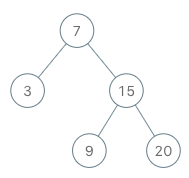
Implement an iterator over a binary search tree (BST). Your iterator will be initialized with the root node of a BST.
Calling
next() will return the next smallest number in the BST.
Example:
BSTIterator iterator = new BSTIterator(root);
iterator.next();    // return 3
iterator.next();    // return 7
iterator.hasNext(); // return true
iterator.next();    // return 9
iterator.hasNext(); // return true
iterator.next();    // return 15
iterator.hasNext(); // return true
iterator.next();    // return 20
iterator.hasNext(); // return false
Note:
next()andhasNext()should run in average O(1) time and uses O(h) memory, where h is the height of the tree.- You may assume that
next()call will always be valid, that is, there will be at least a next smallest number in the BST whennext()is called.
---
Intuition
Saving in order traversal in array list is trivial
We can do better to only save leftmost path on stack
constructor
stack = new Stack<TreeNode>();
getLeftMost(root)
getLeftMost(TreeNode root)
while (root != null) {
stack.push(root);
root = root.left;
}
next
ans = stack.pop()
if (ans.right != null) {
getLeftMost(ans.right)
}
return ans.val;
hasNext
return !stack.isEmpty()
---
Time - O(1) - Amortized for next .. O(N) worst case skewed tree
Space - O(h)
---
