236. Lowest Common Ancestor of a Binary Tree
Given a binary tree, find the lowest common ancestor (LCA) of two given nodes in the tree.
According to the definition of LCA on Wikipedia: “The lowest common ancestor is defined between two nodes p and q as the lowest node in T that has both p and q as descendants (where we allow a node to be a descendant of itself).”
Given the following binary tree: root = [3,5,1,6,2,0,8,null,null,7,4]
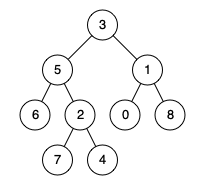
Example 1:
Input: root = [3,5,1,6,2,0,8,null,null,7,4], p = 5, q = 1 Output: 3 Explanation: The LCA of nodes5and1is3.
Example 2:
Input: root = [3,5,1,6,2,0,8,null,null,7,4], p = 5, q = 4 Output: 5 Explanation: The LCA of nodes5and4is5, since a node can be a descendant of itself according to the LCA definition.
Note:
- All of the nodes' values will be unique.
- p and q are different and both values will exist in the binary tree.
---
Intuition
DFS - need to check all nodes
At each node check
1. If current node = p || q, return current node
2. Recurse left, right
3. If both left, and right are not null, we found 1st node above them, return current node - LCA
4. If one of them is not null, return the not null node
---
Time - O(n)
Space - O(1) - ignore function call stack - O(n) - consider function call stack and tree is skewed to one side
---
Related problems
---
Related problems
--
